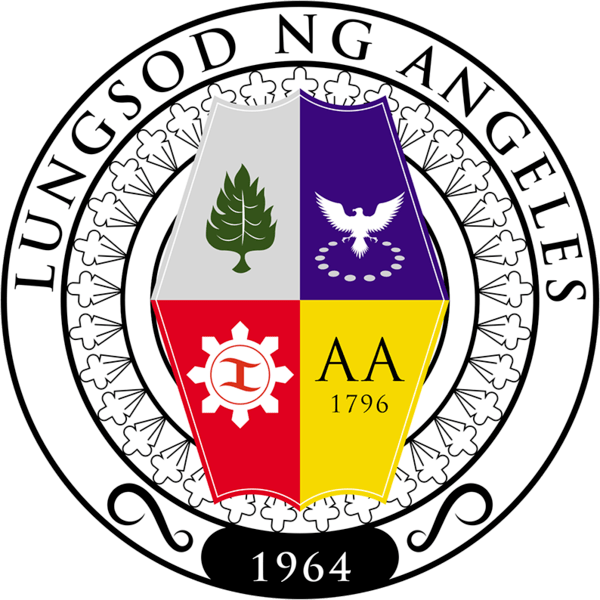
Angeles City, like all other cities, has its own seal. The symbols presented each hold significance to the city, which we will explain further below.
Upper Left-Hand Portion
The golden leaf is modeled purposely after the Antipulu tree, famous for its tallness, its longevity, and its appearance as dignity. The golden Antipulu tree, based on these attributes, symbolize grandeur, permanence, and honor, that will mark the beginning of the future growth and advancement of the city of the Angeles region as a local community that is responsive to the idealism of our great heroes and our nation’s aspirations towards self-determination of greatness. This golden Antipulu leaf is also representative of new leadership that will contribute to the community’s success.
Upper Right-Hand Portion
The hawk (Balawe), holding the symbolic shell of prosperity and leading a flight of small birds, depicts Angeles City’s economic leadership, as well as the economic leadership of other towns of Pampanga portrayed by the small birds.
The blue backdrop represents the vastness of Angeles City’s economic potential, much of which is only waiting to be recognized that can only be accomplished with the help of a new type of leadership and the full participation of all people.
Lower Left-Hand Portion
The red backdrop represents Angeles citizens’ contributions to the cause of independence during the national war against foreign invaders. This color also represents the martyrdom of those Angeles residents who selflessly gave their lives in the fight for social reforms and the protection and uplifting of the oppressed masses.
The war standard of General Emilio Aguinaldo, the great Filipino emperor, is prominently displayed here to commemorate an inspiring historical event in which Angeles played a significant role. In June 1899, Angeles became the seat of the Philippine Republic’s fledgling administration wherein the Pamintuan residence was the Presidential Palace for a short time. June 12, 1898, was the first anniversary of the Declaration of Independence, which was achieved through the Filipino people’s blood, sweat, and sacrifices. These were proudly celebrated in Angeles amidst military parades, civic parades, official speeches, and general rejoicing. The prominent American Forces took part in the military parade and led it. The Angeles Independence Day celebrations were directly officiated by President Aguinaldo and members of his cabinet.
Lower-Right Hand Portion
The letters “AA” stand for the “Angel – Angeles,” serving as the official seal of Don Angel Pantaleon de Miranda, the founder of Angeles. The first clearance of Barrio Culiat, which later become a town and then a city, took place in 1796, which is found below “AA”. The great achievement and success of the founders and people who assisted in turning Barrio Culiat (1796) into a town (1829) in 33 years of war against unkind forces of man and nature, was symbolized by the golden background.
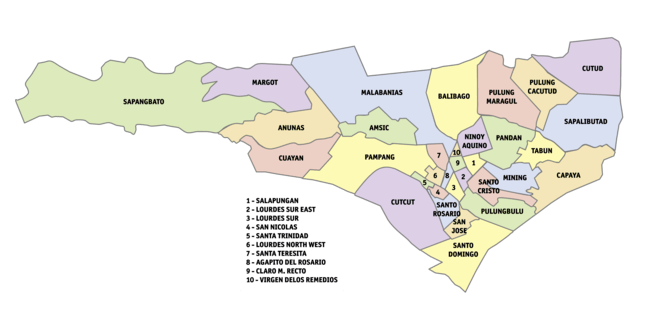
The ancient Filipino shield behind these four symbols represents the Angeles City Government’s duties and obligations that protect and preserve the rights and integrity of all city residents, as democracy demands. The shield is surrounded by the Culiat vine, which has 32 fruit clusters, each representing one of Angeles City’s 32 barangays. To emphasize the revival and preservation of Angeles culture, the words “Lungsod ng Angeles” are written in the style of ancient Tagalog script, and the decoration of the year “1964” is patterned after the Sari-Manok motif. The green background symbolizes the abounding fertility of the agricultural lands of the city of Angels.



 Angeles City: Home of Guardian Angels