The word kapampangan comes from the root pampáng (“riverbank”). The Lakans controlled the Kingdom of Tondo at the time, and the language was spoken there. During the Spanish colonial era, several Kapampangan dictionaries and grammar books were published.
The Pampangan language, also known as Kapampangan, is one of the Philippines’ most widely spoken languages. It is spoken in the provinces of Pampanga, southern part of Tarlac, and northern part of Bataan.
Kapampangan is also spoken in several Bulacan and Nueva Ecija barangays, as well as by the Aitas or Aeta of Zambales. The language was pronounced ‘Capampañgan‘, but is also known as Pampango, as well as Amanung Sisuan, which means “mother language” in the Kapampangan language.
The indigenous Kapampangan script is termed as Kulitan, or Sulat Kapampangan. It is alphasyllabary, meaning diacritical marks alter the consonantal characters that have default vowel sounds. Early 17th and 18th-century Spanish lexicographers recorded these characters as culit, subsequently calling the whole system kulitan.
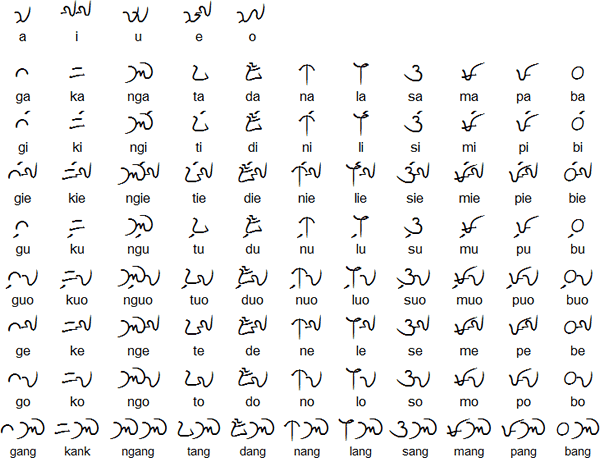
The system is essentially composed of Indung Sulat and Anak Sulat, or the mother and offspring characters, respectively. Indung Sulat serves as the basis for Sulat Kapampangan. These are the base characters with inherent vowel sounds that are unaltered. Anak Sulat is formed by altering these inherent vowel sounds through a diacritical mark or ligature.
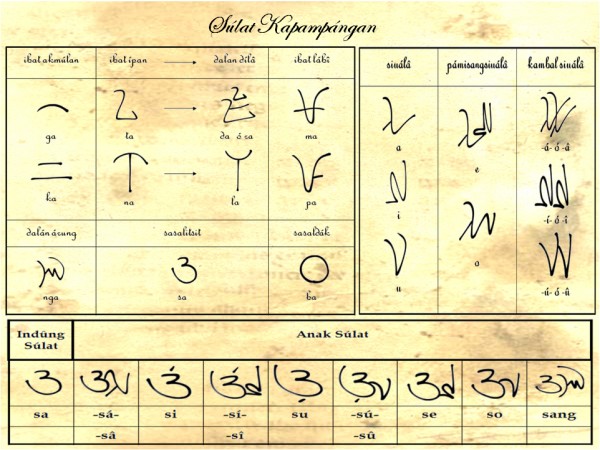
Its origins are uncertain, as it has a striking resemblance to Kawi and other Southeast Asian Indic scripts.
Though its usage declined over the decades, a group of writers established Aguman Sulat Kapampangan in 2008 to keep the language alive and promote its teaching as well. They are Eliver Sicat, John Balatbat, Max Rosales and Bruno Tiotuico.
 Angeles City: Home of Guardian Angels