U.S. Military Encampment
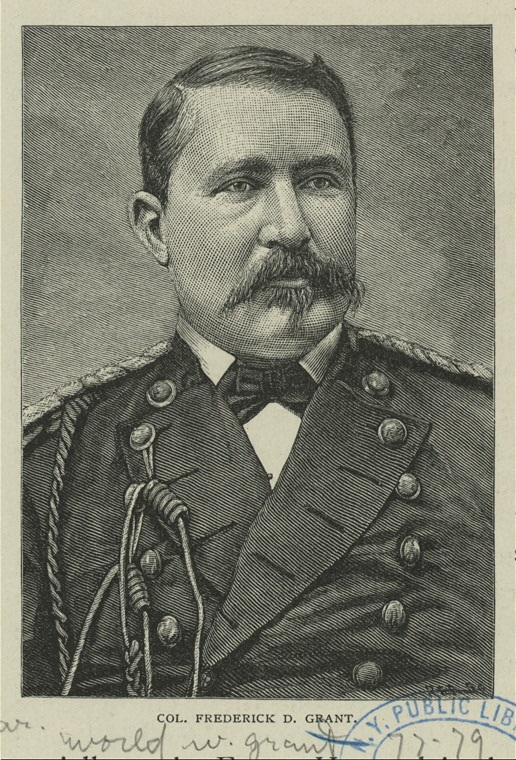
General Frederick D. Grant formed the first United States Civil Government in Angeles in January 1900 by naming an alcalde, or local mayor. This marked the beginning of the American presence in Angeles, which was highlighted by the presence of US armed forces in the city from 1902 to 1991.
The first U.S. Army camp was founded in Barrio Talimundoc (now Lourdes Sur). This lasted about a year, until United States President Theodore Roosevelt signed an executive order designating 7,700 acres (31 square kilometers) of land in Barrio Sapang Bato as Fort Stotsenberg. In 1908, the land area was expanded to 156,204 acres (632.14 sq km) to become Clark Air Base. War planes (DH4s) flew over Angeles for the first time in 1919 from the Clark airfield.
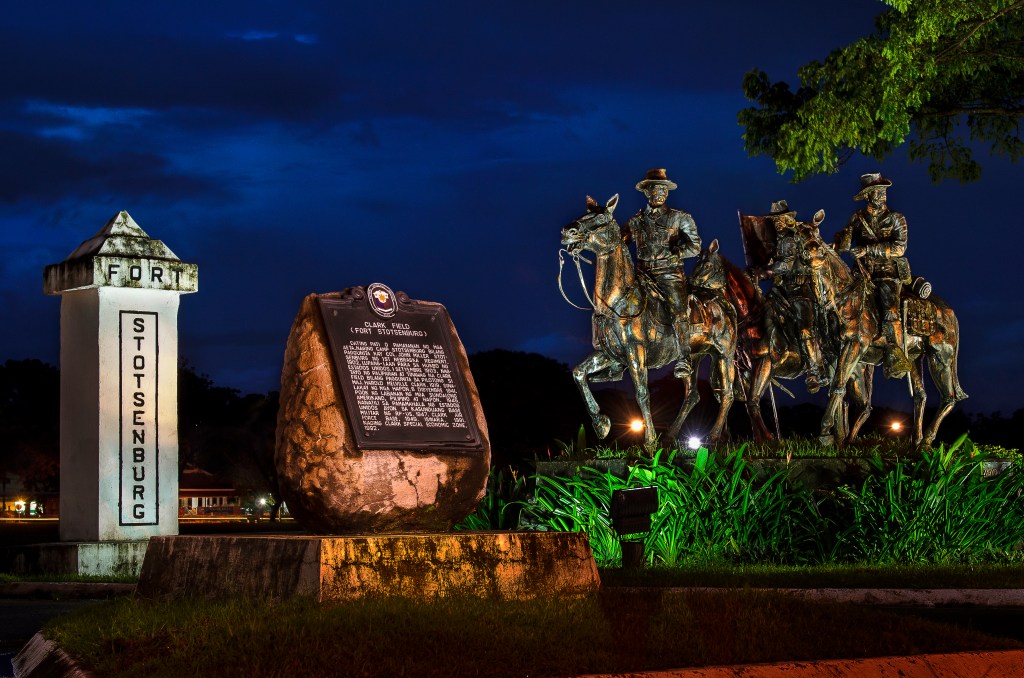
Fort Stotsenburg. (RainJorque, 2013). 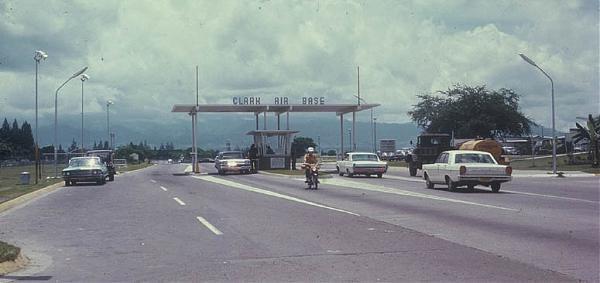
Clark Main Gate Pre-Pinatubo. (Wikimapia, 2012).
Angeles during World War II
Due to the base’s presence, Angeles was subjected to one of World War II’s most devastating air raids, according to historians. Japanese warplanes bombed Clark Field and Angeles on December 8, 1941, killing almost all American warplanes and crippling America’s air force in the Far East. With American military strength weakened, Japanese forces landed in Angeles early on New Year’s Day 1942, occupied the city for three years until January 1945, and seized possession of Fort Stotsenberg. On April 10, 1942, Filipino and American soldiers on their way to the concentration camp in O’Donell, Capas, Tarlac moved through Angeles.
Post-War Period of Angeles
Following World War II and the declaration of Philippine independence on July 4, 1946, the Philippine-American Military Bases Agreement was concluded on March 14, 1947, authorizing the United States to keep Clark Air Base and Subic Naval Base for the next 44 years. Clark serves as the tactical operating U.S. military base, which currently covers 63,103 hectares. This was the only air force base then in Southeast Asia with the ability to accommodate all US military transport planes servicing the Western Pacific. As a result of Clark’s revival, Angeles became home to a larger colony of expatriates, with many Americans settling in the area, especially in the Balibago district.
After the war, Angeles reached new heights as a city. Then, thanks to the efforts of then-Mayor Rafael del Rosario, it was chartered as a city on January 1, 1964, under Republic Act 3700. Attorney Enrique Tayag, an influential citizen of the region, supported him in the preparation of the City Charter, while Congresswoman Juanita L. Nepomuceno of Pampanga’s first district introduced the bill in Congress, which was endorsed by then-President Diosdado Macapagal, a native of the province of Pampanga. Mayor Rafael del Rosario is the last municipal mayor of Angeles and the area’s first mayor after it became a city.
 Angeles City: Home of Guardian Angels